


“The world’s leading robotics company” / Product positioning: “Robots for the Real World”.
Boston Dynamics is a U.S. robotics manufacturer with products including Spot, Stretch, Atlas, and Orbit. Spot is a mobile four-legged inspection robot, Stretch is a mobile warehouse robot for case handling, Atlas is an electric humanoid robot for industrial material handling applications, and Orbit is software for fleet management and data analysis.
Boston Dynamics
Robotic "The world’s leading robotics company"
Location: USA ⓘ Boston Dynamics, Inc., 200 Smith Street, Waltham, MA 02451, USA.
Spot Commercially available four-legged mobile robot for inspection, security, digital twin, construction sites, energy, research, and hazardous environments; includes SDK, payloads, arm, tablet, and support options.
Stretch Commercial warehouse robot for trailer unloading, container unloading, and case handling; operates within existing warehouse infrastructure and is designed for continuous package/case handling processes.
Orbit Robotics fleet and data platform for managing robot deployments, inspection data, site maps, metrics, missions, and integrations with enterprise systems.
Spot Care / Stretch Care Support and service offerings for long-term operation, maintenance, training, and reliable use of robot fleets.
Developer Documentation / SDK Development documentation and SDKs, particularly for Spot, for integrating custom applications, payloads, data flows, and robotics workflows.
Early Adopter / Enterprise Deployment Atlas is currently being rolled out through qualified enterprise inquiries and early deployments; there is no standard public purchasing channel for private individuals. (bostondynamics.com) CE: yes Spot: CE conformity publicly documented.
Stretch: EU conformity officially stated in the brochure.
Atlas: No public record of CE conformity found; verify separately before use in the EU.
Target Audience
Boston Dynamics targets companies, industrial operators, energy providers, construction firms, logistics companies, retail and warehouse operators, research institutions, public safety organizations, and development teams that want to deploy mobile robots in demanding real-world environments. Spot is particularly well-suited for inspection, data collection, and remote/autonomous operations. Stretch is designed for warehouse and case-handling processes. Atlas addresses industrial humanoid applications such as material handling and flexible automation.
Key Features
Boston Dynamics stands out for its exceptionally robust mobile robotics, agility, autonomous navigation, industrial reliability, SDK/integration capabilities, and fleet management. Spot enhances human teams in hazardous, hard-to-reach, or repetitive inspection environments. Stretch automates case handling without requiring major infrastructure overhauls. Atlas is designed to bring humanoid capabilities to industrial workplaces and connect to MES, WMS, and other systems via Orbit.
Key Application Areas
Typical applications include plant inspection, energy and industrial facilities, construction site documentation, digital twins, safety inspections, warehouse automation, container unloading, case handling, retail and logistics processes, material handling, research, robotics development, and fleet management. Atlas is particularly relevant for future enterprise humanoid applications in industrial work environments, while Spot and Stretch are already documented in a more product-oriented manner.
Usage & Notes
: Boston Dynamics robots should always be implemented with training, a safety plan, a risk assessment, a site analysis, usage guidelines, a data protection plan, and a maintenance schedule. For Spot and Stretch, CE and data protection documentation is more comprehensively documented than for many competitors. For Atlas, prior to EU projects, it should be explicitly verified whether CE/conformity documentation, operating instructions, a risk assessment, and integration documentation are already available for the specific system.
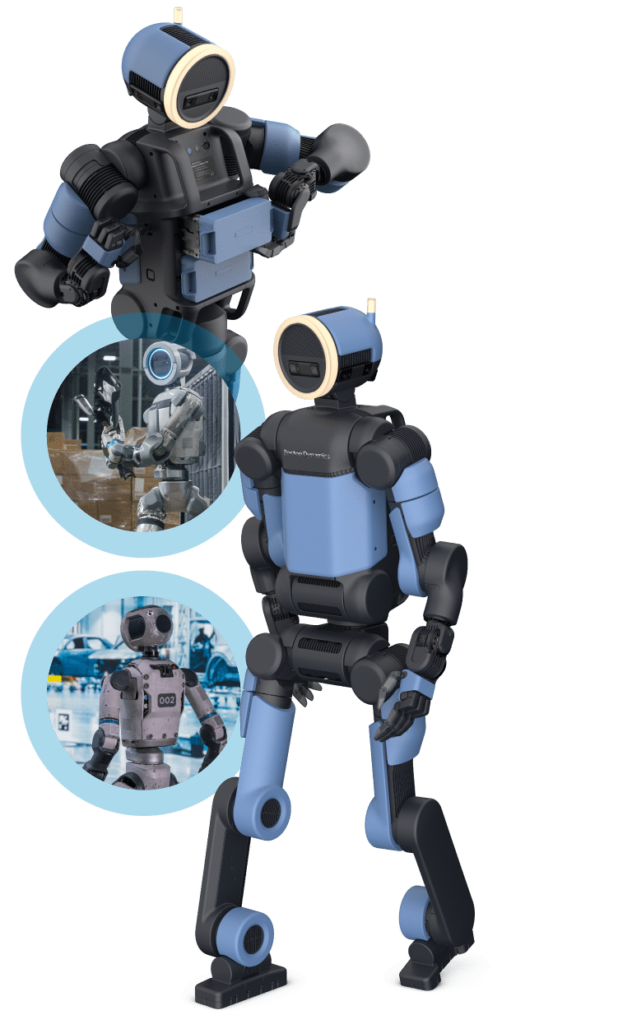
The Boston Dynamics Atlas is an industrial humanoid robot designed for modern automation, material handling, and intelligent robotic processes. The fully electric platform was developed for real-world work environments and combines high power, autonomous navigation, AI-powered learning, and flexible mobility. Atlas can perform tasks with minimal supervision, scan barcodes, integrate into existing workflows, and change its own battery. With 56 degrees of freedom, 360-degree camera vision, tactile sensors, and a robust design, Atlas is engineered for demanding industrial applications. Its use in industry, logistics, manufacturing, and research is particularly exciting, where humanoid robots will be able to take over monotonous, physically demanding, or complex tasks in the future.
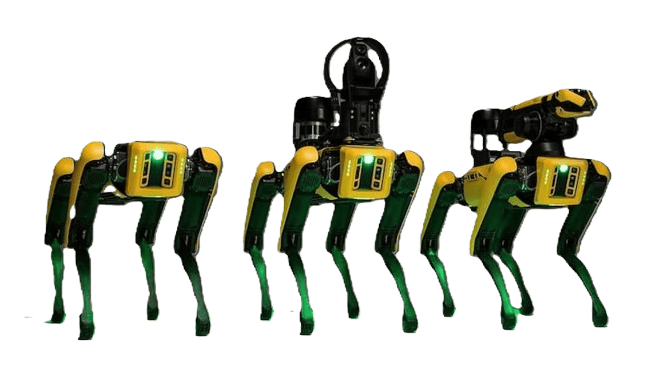
The Boston Dynamics Spot is an agile four-legged robot designed for industrial inspection, data collection, security tasks, and autonomous operations in challenging environments. The mobile robot platform uses 360-degree perception, autonomous navigation, and flexible payloads to efficiently monitor facilities, construction sites, energy infrastructure, factories, and research laboratories. Spot can be expanded with additional sensors, cameras, communication modules, or the Spot Arm, thereby also supporting manipulation tasks. With high off-road capability, a robust design, and scalable software, Spot is particularly well-suited for recurring inspection rounds, digital twins, high-risk areas, and data-driven operational optimization. This enables companies to automate inspections, reduce the workload on employees, and monitor hazardous locations more safely.
| Target audience | Assessment |
|---|---|
| Private individuals | No – According to the FAQ, Boston Dynamics products are intended for commercial, industrial, enterprise, and university research, not for private individuals. |
| Self-employed / Freelancers | Rarely to somewhat – only useful for specialized robotics, automation, research, or integration projects. |
| SMEs | To a limited extent – suitable for specialized inspection, warehouse automation, research, or pilot projects, but requires significant implementation and security effort. |
| Large enterprises | Very well suited – especially for manufacturing, automotive, logistics, warehouse automation, inspection, energy, security, and research. |
| Developers / Research Teams | Yes – relevant due to Spot SDK, development documentation, integrations, Orbit, robotics data, and enterprise pilot projects. |
| Education / Universities | Yes – suitable for advanced robotics research, autonomous systems, manipulation, perception, and industrial automation. |
| Organizations with data protection concerns | To a limited extent – clear privacy and robot privacy documents are a positive; processing of service logs and performance metrics in the U.S. requires critical review. |
| Security-Critical Organizations | Yes, with strict review – Boston Dynamics offers robotics for hazardous, industrial, and safety-critical environments; deployment requires a safety, cybersecurity, and governance framework. |
Hosting & Data
1) On-prem / local hosting
Meaning: The company operates the solution on its own hardware or within its own infrastructure. In the strictest sense, not only the application runs locally, but ideally the model as well.
2) Private cloud / data center
Meaning: The solution runs in a dedicated or more clearly separated cloud environment, often with a hosting provider or hyperscaler, but in a German data center or in a particularly controlled environment.
3) EU SaaS / managed
Meaning: The provider operates the solution itself as a service. The company uses the tool as a ready-made cloud service, ideally with EU data residency.
4) Hybrid
Meaning: One part of the processing remains internal / local / in a private cloud, while another part runs in an external cloud or EU SaaS.
5) AVV / DPA
Meaning: This is the data processing agreement or Data Processing Addendum. It governs that the provider processes personal data on behalf of the customer and is bound by the customer's instructions.
6) No training
Meaning: The provider does not use your prompts, uploads, attachments, chat histories, or outputs for training or improving the general model — ideally excluded by contract.
7) Open-source / transparency path
Meaning: There is a path toward greater technical transparency and sovereignty, for example through:
- open models
- documented components
- self-hostable parts
- traceable architecture
- export / switching options
| On-prem / local hosting | ✅ |
| Private cloud / data center | ⚠️ |
| EU SaaS / Managed | ⚠️ |
| Hybrid | ⚠️ |
| DPA / AVV | ❓ |
| No training on customer data | ❓ |
| Open source / transparency path | ⚠️ |
On-premises / local hosting: supported
The Orbit product page explicitly lists on-premises deployment options: “Site Hub” as a “1U rack-mounted network application installed on-premises,” as well as a VM option via OVA for VMware, Hyper-V, Azure, and Google Cloud.
Private Cloud / Data Center: Partially
A segregated environment can be inferred indirectly, as the Orbit security sheet mentions “Unique domain and AWS CA TLS certificate per customer” and the product page describes VM-based and customer-side deployments. However, the website does not specifically describe an explicit private cloud offering in the EU/EEA with dedicated data centers.
EU SaaS / Managed: Partially
Orbit is available as a cloud product, and according to the Spot Privacy Notice, the data region is specified at the time of purchase. This suggests regional control. The website does not specify explicit EU/EEA data residency, specific EU data centers, or a standard EU SaaS deployment.
Hybrid: Partially
The website lists both cloud and on-premises/VM options. Additionally, service logs and performance metrics can be selectively or configurably transmitted to Boston Dynamics. However, the website does not describe an architecture explicitly labeled as a “hybrid” model.
DPA: unclear
No explicit DPA was found on the website. General terms, a privacy policy, and product-related notices are available, but there is no clearly identified data processing agreement.
No Training: Indirect / Not Available
The website does not state that customer data is contractually excluded from the training of general AI models. On the contrary, the Spot Privacy Notice states that service logs and Orbit service logs may be used for troubleshooting and “product and service improvements”; the Orbit Terms of Service also state that Orbit may collect data used for support or performance improvements. A specific AI training opt-out is not specified on the website.
Open Source / Transparency Path: Partial
There is a certain degree of transparency and control through on-premises and VM deployments, as well as documented APIs and integrations. However, the website does not mention any open-source components, open models, or an open-source deployment.
Data Processing
According to the website, Orbit is available as web-based software and is hosted in the cloud by Boston Dynamics on AWS. In addition, there are local or customer-side deployment options via “Site Hub” and VM. Orbit Cloud Data includes, among other things, inspection data, images, videos, acoustic data, metadata, mission data, maps, operational history, and user data. According to the Spot Privacy Notice, Orbit data is stored in the region specified at the time of purchase, while transmitted service logs and performance metrics are processed in the United States. A list of subprocessors is not provided on the website.
Conclusion
From a website perspective, Boston Dynamics does not clearly demonstrate to EU/EEA users that it is a fully documented GDPR-compliant standard SaaS solution. The most viable approach appears to be a conditional path via on-premises/VM operation or a strictly configured deployment with regional data storage and additional contractual safeguards. For pure cloud usage, significant uncertainties remain due to U.S. connections, the absence of an explicit AVV/DPA on the website, the inability to locate a list of subprocessors, and the lack of a clear “no-training” commitment.
Sources
- https://bostondynamics.com/privacy-policy/
- https://bostondynamics.com/products/spot/privacy-notice/
- https://bostondynamics.com/products/orbit/
- https://bostondynamics.com/wp-content/uploads/2024/02/orbit-security.pdf
- https://bostondynamics.com/wp-content/uploads/2024/03/orbit-terms-and-conditions-of-sale.pdf
- https://bostondynamics.com/blog/robot-fleet-management-lifts-off-with-spot/
Strengths & weaknesses at a glance
| Strengths | Weaknesses |
|---|---|
| • Very high level of technical maturity in mobile robotics | • Atlas is not yet a freely scalable standard product; currently deployed via early enterprise/customer channels |
| • Commercial products Spot and Stretch, including support, training, and documentation | • High investment, integration, training, and maintenance costs are expected |
| • Public CE conformity documents for Spot and EU conformity information for Stretch | • Robots potentially collect sensor, image, acoustic, performance, and log data |
| • Clear usage and ethical guidelines to prevent weaponization | • U.S. provider; international data transfers and DPA/security documentation must be reviewed |
| • Spot SDK, developer documentation, Orbit fleet management, and integration paths | • Expressly unsuitable for household/consumer use, particularly Spot |
| • Enterprise focus on manufacturing, inspection, logistics, energy, construction, public safety, and warehouse automation |
Reviews
0 reviews in total
There are no confirmed reviews for this tool yet.
Submit review
Your review will only become visible after email confirmation. This protects the portal against abuse.
Report review
Please select the reason why this review should be checked.
GDPR-compliant usage possible?
The website documents certain data protection and security measures for users in the EU/EEA, but does not provide full, clearly documented GDPR compliance for the entire solution. Positive aspects include a general reference in the privacy policy to EEA/GDPR rights, selectable data regions for Orbit data, and on-premises/VM deployment options. At the same time, the website mentions data transfers to the U.S., uses AWS for the hosted Orbit offering, and does not display an explicit AVV/DPA or a list of subprocessors on the website. From an EU/EEA perspective, GDPR-compliant use therefore appears plausible only under certain conditions, particularly with appropriate contract terms and preferably with local or customer-controlled deployment.
Positive
The following are positively documented: a privacy policy with an explicit section for individuals in the EEA, Orbit data storage in the region specified at the time of purchase, on-premises options via “Site Hub” or VM deployment, data encryption, SSO support, and a “SOC2 Type II certified” designation mentioned on the Orbit product page.
Negative
Negative or incomplete: The website does not specify a concrete EU/EEA server location for the cloud offering, but only mentions AWS and a region requested by the customer. The general privacy policy states that personal data may be transferred to other countries. The Spot Privacy Notice also states that service logs and performance metrics transmitted to Boston Dynamics are processed in the U.S. An explicit Data Processing Agreement (DPA), a list of subprocessors, a reliable statement regarding EU data residency as the standard, and a clear commitment that customer data will not be used to train general AI models are not provided on the website.
Server Location
For Orbit Cloud, the website lists AWS as the hosting provider and states that Orbit data is stored in the region selected at the time of purchase. A specific EU/EEA data center location is not specified on the website. For service logs and performance metrics transmitted to Boston Dynamics, the Spot Privacy Notice specifies that processing takes place in the U.S.