


“The Global Leader in Social Humanoid Robotics” / “Engineering the world’s most advanced social humanoid robots.”
Engineered Arts develops and builds humanoid robots for social interaction, entertainment, education, research, events, and public installations. The flagship Ameca is a full-scale, interactive, and programmable humanoid robot equipped with cameras, microphones, speakers, and 61 degrees of freedom. All current robots are operated via the Tritium software platform.
Engineered Arts
The Global Leader in Social Humanoid Robotics" / "Engineering the world's most advanced social humanoid robots.
Location: United Kingdom ⓘ Engineered Arts Limited is registered at Companies House as an active Private Limited Company.
Target audience
Engineered Arts is primarily aimed at organizations that wish to use humanoid robots as a visible, interactive interface between humans and AI. Typical target groups include museums, science centers, research institutes, universities, corporate innovation labs, trade show organizers, brand and event agencies, leisure attractions, visitor centers, and companies with a high demand for spectacular customer interaction. Due to hardware requirements, security standards, installation complexity, and data protection obligations, the solution is suitable for private individuals or traditional office users only in exceptional cases.
Outstanding features
Engineered Arts’ greatest strength lies in its combination of lifelike humanoid design, expressive facial expressions, audiovisual dialogue, and a proprietary control platform. Ameca offers 61 degrees of freedom, cameras, microphones, and speakers for direct human-robot interaction. The Tritium platform combines the Robot Operating System, browser-based operation, and cloud services; according to the manufacturer, Tritium AI supports speaking, listening, translating, and generative responses via integrated AI technologies.
Key Areas of Application
Engineered Arts robots are particularly well-suited for presentations, public installations, education, research on human-robot interaction, event marketing, interactive exhibitions, product demonstrations, visitor engagement, and social robotics projects. Ameca and the desktop variants are designed for observing, listening, speaking, and interacting; they are not described as service robots performing physical labor, care assistants, or autonomous outdoor robots. The official documentation explicitly limits their use to indoor environments and excludes physical interaction with people, animals, or objects.
Usage & Notes
The robot is operated via the Tritium software platform, which features a web-based interface and, according to the documentation, can be accessed via any internet-enabled computer. For desktop robots, a wired internet connection is specified; for Ameca, safety zones, LiDAR sensors, moving parts, power supply, and startup/shutdown procedures must be taken into account. Operators should plan a clear interaction script, moderation concept, safety concept, data protection concept, and a fallback communication plan before live deployment, as the robot is not intended for critical factual information such as evacuation routes or medical diagnoses, according to the documentation.
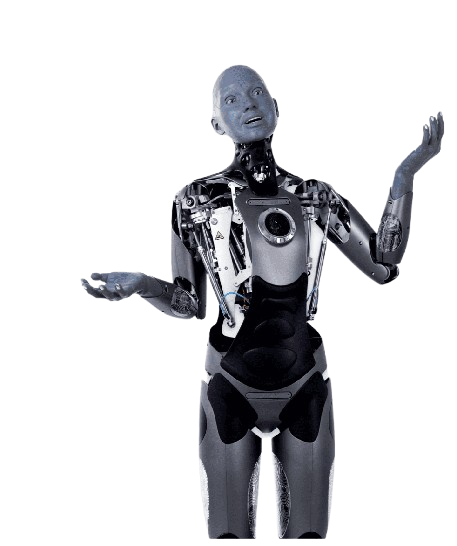
Ameca, developed by Engineered Arts, is considered an advanced platform for humanoid robotics, artificial intelligence, and natural human-robot interaction. The humanoid robot was designed for research, development, events, education, and high-impact public demonstrations. With 61 degrees of freedom, Ameca produces exceptionally fluid head, arm, hand, and facial movements. Movable eyebrows, eyes, cheeks, and mouth allow for expressive, human-like communication. Cameras, microphones, spatial audio capture, and the Tritium software platform support environmental perception as well as the integration of external AI and language models. Ameca can hold conversations, respond to people, and convey content clearly. Safety features such as emergency stop switches and LiDAR sensors support controlled operation in various environments. The modular design facilitates maintenance, further development, and customer-specific customizations. Developers can test new applications, dialogue systems, and interactive scenarios with a high degree of flexibility and integrate them into existing presentation or research environments. This makes Ameca particularly well-suited as a modern research robot, demonstration platform, digital brand ambassador, and interactive humanoid robot for innovative projects.
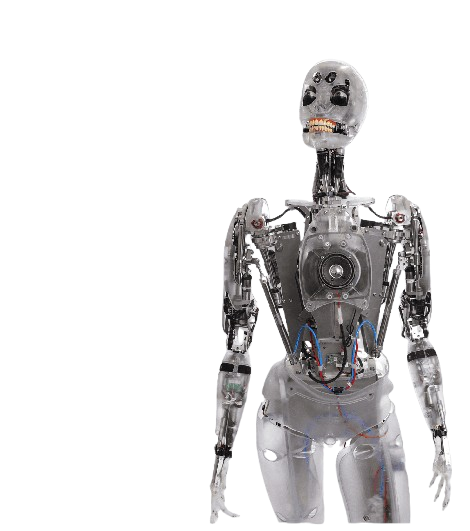
Mesmer by Engineered Arts is a highly realistic humanoid robot designed for entertainment, presentations, exhibitions, and interactive brand experiences. Its human-like facial expressions, precise movements, and customizable appearance make it a striking eye-catcher at trade shows, in museums, amusement parks, or interactive experiences. With 61 degrees of freedom, Mesmer can perform natural facial movements, postures, and gestures. A preconfigured animation library offers more than 70 realistic facial expressions, poses, and motion sequences. Via microphones, spatial audio capture, and the Tritium software platform, the robot can be connected to voice systems and AI applications. This allows Mesmer to address visitors, answer questions, and react to its surroundings. Its external appearance can be customized to resemble specific people, characters, or brands. Operators can specifically configure movements, dialogues, and presentation sequences to develop recognizable scenarios for different target audiences. This makes the humanoid robot particularly suitable for companies, research institutions, and event organizers who wish to present emotional, credible, and technically sophisticated human-robot interactions.
| Target audience | Assessment |
|---|---|
| Private individuals | No to strongly limited – not described as a household or consumer robot; professional installation, safety, maintenance, data protection, and cost structure argue against private use. |
| Self-employed / Freelancers | Limited – useful for specialized event, film, trade show, PR, robotics, or experience service providers; not a practical productivity tool for typical freelancers. |
| SMEs | Conditional to good – suitable for museums, educational providers, showrooms, retail experiences, brand activation, and events; less suitable for standard operational processes. |
| Large enterprises | Well-suited – especially for innovation labs, visitor centers, research, corporate events, brand communication, and attention-grabbing product presentations. |
| Sales / Recruiting / Customer Success | Limited – very strong as a trade show or visitor interaction point; not a full-fledged recruiting, CRM, or customer success system without additional integrations. |
| Developers / Technical Teams | Well-suited – Ameca is programmable and can execute customer-side algorithms; Tritium is web-based and includes an OS, browser software, and cloud services. Note the proprietary ecosystem. (Engineered Arts User Documentation) |
| Organizations with data protection concerns | Limited – The UK Adequacy Decision and Trust Center claim are positive; however, due to cameras, microphones, third-party AI providers, potential cloud processing, an unclear server location, and a non-publicly verified AVV/DPA, a case-by-case assessment remains mandatory. (Trust Engineered Arts) |
Hosting & Data
1) On-prem / local hosting
Meaning: The company operates the solution on its own hardware or within its own infrastructure. In the strictest sense, not only the application runs locally, but ideally the model as well.
2) Private cloud / data center
Meaning: The solution runs in a dedicated or more clearly separated cloud environment, often with a hosting provider or hyperscaler, but in a German data center or in a particularly controlled environment.
3) EU SaaS / managed
Meaning: The provider operates the solution itself as a service. The company uses the tool as a ready-made cloud service, ideally with EU data residency.
4) Hybrid
Meaning: One part of the processing remains internal / local / in a private cloud, while another part runs in an external cloud or EU SaaS.
5) AVV / DPA
Meaning: This is the data processing agreement or Data Processing Addendum. It governs that the provider processes personal data on behalf of the customer and is bound by the customer's instructions.
6) No training
Meaning: The provider does not use your prompts, uploads, attachments, chat histories, or outputs for training or improving the general model — ideally excluded by contract.
7) Open-source / transparency path
Meaning: There is a path toward greater technical transparency and sovereignty, for example through:
- open models
- documented components
- self-hostable parts
- traceable architecture
- export / switching options
| On-prem / local hosting | ⚠️ |
| Private cloud / data center | ❓ |
| EU SaaS / Managed | ❓ |
| Hybrid | ⚠️ |
| DPA / AVV | ❓ |
| No training on customer data | ❓ |
| Open source / transparency path | ⚠️ |
On-prem / local hosting: partially
The website describes an embedded robot PC, Tritium OS based on its own Linux/Yocto framework, and local processing whenever possible. However, Mesmer/Tritium does not explicitly offer a complete on-premise or fully self-hosted local solution.
Private Cloud / Data Center: Unclear
Not specified on the website. There is no specific statement regarding dedicated private cloud environments or geographically isolated EU/EEA data centers.
EU SaaS / Managed: Indirect / Not Available
Tritium and Tritium AI are described as cloud-based, but EU/EEA data residency or EU hosting are not specified on the website.
Hybrid: Partially
The combination of a local robot PC or local processing where possible and cloud-based Tritium AI indirectly suggests a hybrid operating model. However, a formal hybrid architecture or EU-specific configuration is not explained.
DPA: unclear
Not specified on the website. No TPA/DPA or page regarding the data processing agreement was found.
No Training: Unclear
Not specified on the website. No clear statement was found indicating that prompts, uploads, conversation histories, or outputs are not used to train general AI models, nor was an opt-out option found.
Open Source / Transparency: Partial
The website mentions its own Tritium OS based on a custom Linux/Yocto build, as well as software written in C++, Rust, and Python, and includes a link to “Open Source” in the footer. However, for Mesmer/Tritium, the pages reviewed did not document any reliable disclosure of the relevant components or a clear, self-hostable open-source path.
Data Processing
The website describes Mesmer as featuring an embedded robot PC, Tritium OS, and a cloud-based Tritium/Tritium AI platform. Regarding privacy, it states that data processing takes place locally whenever possible and that external transmission and storage are minimized. At the same time, Tritium AI is explicitly described as a cloud-based solution for LLMs, TTS, ASR, and NLP. This suggests a mix of local and external processing; the website does not specify where exactly this cloud is operated or which subcontractors are involved.
Conclusion
For users in the EU/EEA, the website currently lacks sufficient specificity on data protection issues to justify a reliable GDPR approval. There are positive signs, such as local processing where possible, data protection claims, and proprietary technical platforms, but the website lacks the crucial evidence required for use in Europe: EU/EEA data residency, server locations, Data Processing Agreement (DPA), subprocessors, and “no training” commitments. Therefore, the overall assessment is “unclear.”
Sources
| On-prem / local hosting | ⚠️ |
| Private cloud / data center | ❓ |
| EU SaaS / Managed | ❓ |
| Hybrid | ⚠️ |
| DPA / AVV | ❓ |
| No training on customer data | ❓ |
| Open source / transparency path | ⚠️ |
On-prem / local hosting: partially
The website describes an embedded robot PC, Tritium OS based on its own Linux/Yocto framework, and local processing whenever possible. However, Mesmer/Tritium does not explicitly offer a complete on-premise or fully self-hosted local solution.
Private Cloud / Data Center: Unclear
Not specified on the website. There is no specific statement regarding dedicated private cloud environments or geographically isolated EU/EEA data centers.
EU SaaS / Managed: Indirect / Not Available
Tritium and Tritium AI are described as cloud-based, but EU/EEA data residency or EU hosting are not specified on the website.
Hybrid: Partially
The combination of a local robot PC or local processing where possible and cloud-based Tritium AI indirectly suggests a hybrid operating model. However, a formal hybrid architecture or EU-specific configuration is not explained.
DPA: unclear
Not specified on the website. No TPA/DPA or page regarding the data processing agreement was found.
No Training: Unclear
Not specified on the website. No clear statement was found indicating that prompts, uploads, conversation histories, or outputs are not used to train general AI models, nor was an opt-out option found.
Open Source / Transparency: Partial
The website mentions its own Tritium OS based on a custom Linux/Yocto build, as well as software written in C++, Rust, and Python, and includes a link to “Open Source” in the footer. However, for Mesmer/Tritium, the pages reviewed did not document any reliable disclosure of the relevant components or a clear, self-hostable open-source path.
Data Processing
The website describes Mesmer as featuring an embedded robot PC, Tritium OS, and a cloud-based Tritium/Tritium AI platform. Regarding privacy, it states that data processing takes place locally whenever possible and that external transmission and storage are minimized. At the same time, Tritium AI is explicitly described as a cloud-based solution for LLMs, TTS, ASR, and NLP. This suggests a mix of local and external processing; the website does not specify where exactly this cloud is operated or which subcontractors are involved.
Conclusion
For users in the EU/EEA, the website currently lacks sufficient specificity on data protection issues to justify a reliable GDPR approval. There are positive signs, such as local processing where possible, data protection claims, and proprietary technical platforms, but the website lacks the crucial evidence required for use in Europe: EU/EEA data residency, server locations, Data Processing Agreement (DPA), subprocessors, and “no training” commitments. Therefore, the overall assessment is “unclear.”
Sources
Strengths & weaknesses at a glance
| Strengths | Weaknesses |
|---|---|
| - Very strong visual presence and PR/event impact | - Not a consumer product and not a free version |
| - Distinct human facial expressions and social interaction | - Not designed for physical interaction with people, animals or objects |
| - Suitable for museums, research labs, visitor centers, brand staging and educational formats | - Not suitable for outdoor areas, wet/dusty environments or extreme temperatures |
| - Programmable platform for customer algorithms and R&D | - Not intended for important factual information such as escape route descriptions or medical diagnoses according to documentation |
| - Desktop versions available for more compact installations | - Data protection check complex as cameras, microphones, cloud services and third-party AI may be involved |
Reviews
0 reviews in total
There are no confirmed reviews for this tool yet.
Submit review
Your review will only become visible after email confirmation. This protects the portal against abuse.
Report review
Please select the reason why this review should be checked.
GDPR-compliant usage possible?
Although the website contains several statements regarding data protection, local processing whenever possible, and general GDPR compliance, it does not include a robust privacy policy with details on product data processing, specific server or data center locations, EU/EEA data residency, a data processing agreement (DPA), a list of subprocessors, or a robust opt-out option for AI training. The documentation is therefore too incomplete to allow for a reliable assessment of GDPR compliance throughout the EU/EEA.
On the positive side
On the positive side, according to the website, Mesmer and Tritium were developed with a focus on data protection and security; data processing takes place locally whenever possible; encrypted and secure data processing is mentioned; and the website repeatedly refers to GDPR compliance and international privacy standards. In addition, the website describes its own robotics software platform comprising Tritium, Tritium OS, and a user-side Python IDE, which suggests a certain degree of technical control.
Negative
On the negative side, the website provides no concrete evidence of EU/EEA hosting, no specific data centers are named, no Data Processing Agreement (DPA), no subprocessors, no statement regarding international data transfers, no product-specific statement on the retention of interaction data, and no clear assurance that user inputs, uploads, or conversation data are not used to train general models. Furthermore, certifications are not reliably documented on the Mesmer and Tritium pages found.
Server location
Not specified on the website. The only information found was that Tritium AI is described as a cloud-based solution and that data processing takes place locally whenever possible; specific server or data center locations in the EU/EEA are not mentioned.