


“Empowering Every Home with Robotics”
Noetix Robotics develops compact and full-size humanoid robots for education, research, entertainment, developers, corporate demonstrations, and, in the future, private households. Bumi is positioned as a lightweight entry-level and educational robot, N2 focuses more on dynamic movement and research, and E1 on voice interaction, service, and embodied AI.
Noetix Robotics
Empowering Every Home with Robotics
Location: China ⓘ Noetix Robotics (Beijing) Technology Co., Ltd., Building 1, Tower B, Future Vision, No. 3 Yard, Binhe Avenue, Future Science and Technology City, Xiaotangshan Town, Changping District, Beijing, China.
Target audience
Noetix Robotics is designed for universities, schools, robotics labs, makers, developers, tech enthusiasts, event organizers, and companies looking to explore humanoid robotics with relatively low barriers to entry. Bumi is particularly well-suited for education and learning to code. N2 is designed for motion research and dynamic robotics, while E1 is intended for embodied AI, voice interaction, exhibitions, and service concepts.
Outstanding features
Bumi offers visual programming, smartphone control, customizable movements, a camera, an IMU, a voice module, and optional Jetson computing power. N2 is designed for dynamic movement, jumping, dancing, and research. E1 combines a larger humanoid body with voice interaction, optional dexterous hands, and optional LiDAR.
Key Areas of Application
Typical applications include robotics training, programming courses, reinforcement learning, motion control, human-robot interaction, trade show demonstrations, entertainment, research, in-store guides, and experimental companion or service applications. There is insufficient evidence for safety-critical, medical, or unsupervised tasks.
Usage & Notes
Before making a purchase, you should carefully determine which model, computing module, and SDK are required. International procurement may entail additional requirements regarding importation, CE conformity, radio certification, spare parts, and warranty. In the EU, the robot should initially be operated on a segregated network, and all outbound data traffic should be documented.
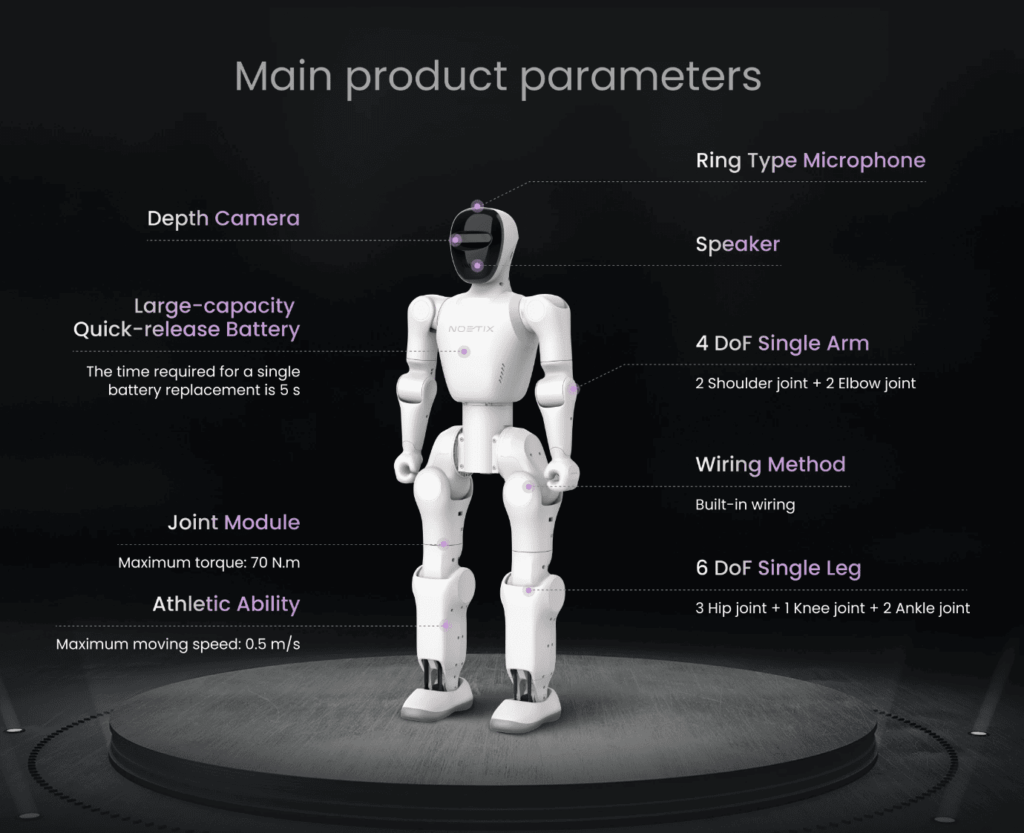
Bumi “AI Sweet Mate” is a compact humanoid robot from Noetix Robotics designed for families, education, and tech enthusiasts. Standing approximately 98 centimeters tall, with 21 degrees of freedom and a battery life of about two to three hours, Bumi combines movement, voice interaction, and visual object recognition. The robot can stand up, walk, and dance on its own and respond to voice commands. Users can program their own movement sequences via a mobile app. This makes Bumi particularly suitable for maker education, programming courses, interactive learning, and a playful introduction to humanoid robotics.
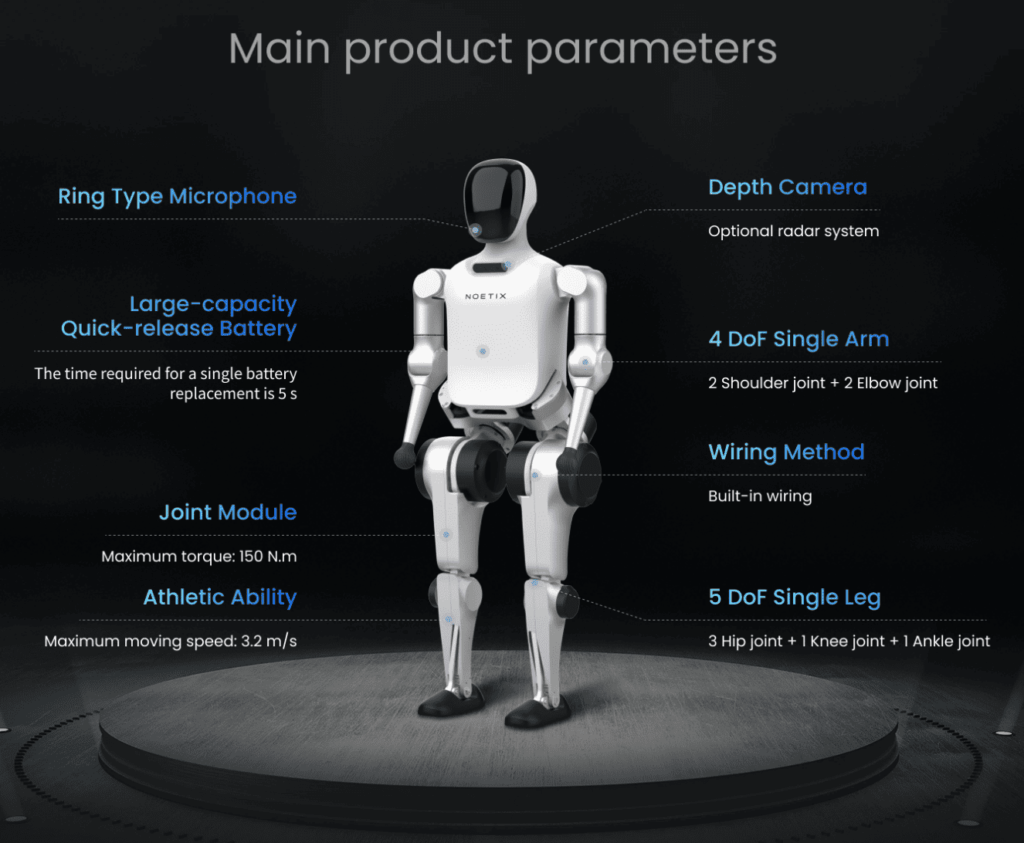
The Noetix N2 “Athlete” is a high-performance humanoid robot designed for dynamic movement, research, education, and robotics competitions. Its lightweight biomimetic design and precise motion control enable dancing, jumping, fast running, and consecutive backward somersaults. With a maximum joint torque of 150 Newton-meters, the N2 can handle even complex motion sequences and various surfaces. A visual programming and teaching function allows for the customization of poses and actions. This makes the humanoid robot particularly suitable for universities, research laboratories, developers, sporting events, and sophisticated demonstration projects in the field of modern robotics.
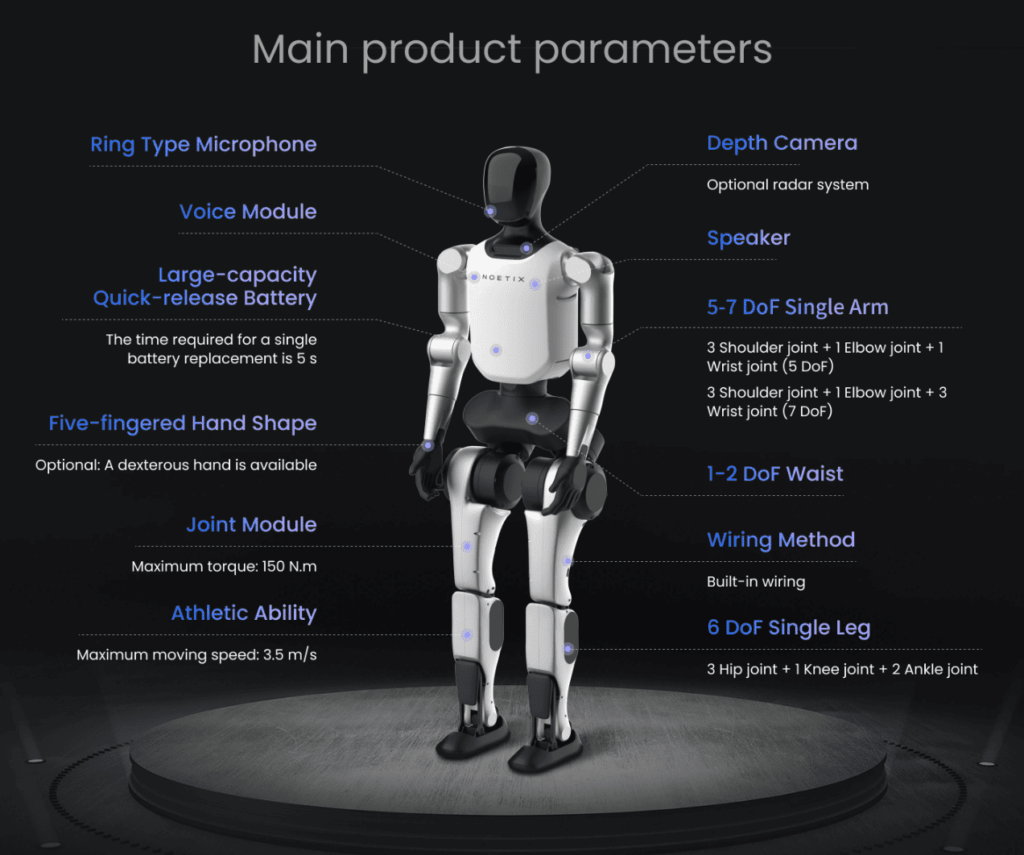
The Noetix E1 “Geek Vanguard” is a versatile humanoid robot designed for research, education, development, and commercial applications. In-house developed, high-precision motion algorithms enable stable walking on complex surfaces as well as dynamic actions such as dancing and jumping. For natural communication, the E1 uses AI-based voice interaction that supports multi-step dialogues and context-sensitive commands. Thanks to its modular design, the robot can be equipped with dexterous robotic hands, LiDAR, and other expansion modules. This makes the E1 a flexible platform for robotics projects, programming, education, and custom developments.
| Target audience | Assessment |
|---|---|
| Private individuals | Conditional to yes, especially Bumi – Bumi is positioned for family support, interest in technology, and learning to code. Safety, import, CE compliance, and data protection must be verified. |
| Self-employed / Freelancers | Conditional to yes – suitable for events, exhibitions, training, content, demonstrations, and robotics projects. |
| SMEs | To a limited extent – E1 and the bionic models may be of interest for reception, presentations, consulting, or exhibitions; EU service and compliance are unclear. |
| Large enterprises | To a limited extent – conceivable for research, showrooms, service, and pilot projects; a robust European enterprise, compliance, and support structure has not been publicly documented. |
| Developers / Research Teams | Yes – Noetix offers SDK documentation, secondary development, open motion control, and EDU versions. |
| Education / Universities | Very well suited – Bumi, N2, and E1 are explicitly positioned for maker education, programming education, campus use, and university research. |
| Entertainment / Events | Very well suited – N2 is designed for movement, dance, jumps, and demonstrations; Hobbs 3 and W1 focus on realistic interaction. |
| Home / Companion | To a limited extent – Bumi and E1 are cited for family assistance, but are still in an early stage of product and market development. |
| Data Protection-Critical Organizations | Somewhat critical – personal website data is stored in China; product-specific data flows, DPA, SCCs, and EU data residency are not secured. |
Hosting & Data
1) On-prem / local hosting
Meaning: The company operates the solution on its own hardware or within its own infrastructure. In the strictest sense, not only the application runs locally, but ideally the model as well.
2) Private cloud / data center
Meaning: The solution runs in a dedicated or more clearly separated cloud environment, often with a hosting provider or hyperscaler, but in a German data center or in a particularly controlled environment.
3) EU SaaS / managed
Meaning: The provider operates the solution itself as a service. The company uses the tool as a ready-made cloud service, ideally with EU data residency.
4) Hybrid
Meaning: One part of the processing remains internal / local / in a private cloud, while another part runs in an external cloud or EU SaaS.
5) AVV / DPA
Meaning: This is the data processing agreement or Data Processing Addendum. It governs that the provider processes personal data on behalf of the customer and is bound by the customer's instructions.
6) No training
Meaning: The provider does not use your prompts, uploads, attachments, chat histories, or outputs for training or improving the general model — ideally excluded by contract.
7) Open-source / transparency path
Meaning: There is a path toward greater technical transparency and sovereignty, for example through:
- open models
- documented components
- self-hostable parts
- traceable architecture
- export / switching options
| On-prem / local hosting | ❓ |
| Private cloud / data center | ❓ |
| EU SaaS / Managed | ❓ |
| Hybrid | ❓ |
| DPA / AVV | ❓ |
| No training on customer data | ⚠️ |
| Open source / transparency path | ⚠️ |
On-Prem / local hosting: indirect / not available
The website describes physical robots, SDKs, and development tools, which suggests local use of individual components. However, the website does not explicitly state an on-prem/self-hosting option for a complete service or a locally operated AI model.
Private cloud / data center: unclear
Not specified on the website. No dedicated customer environments, no private cloud, and no segregated data center options were described.
EU SaaS / managed: unclear
Not specified on the website. Instead, the website privacy policy states that personal data is stored in China; EU data residency or an EU/EEA data center was not mentioned.
Hybrid: unclear
Not specified on the website. There is no reliable description of a hybrid processing architecture between local operation and external cloud.
DPA / AVV: unclear
Not specified on the website. No AVV/DPA, no corresponding contract page, and no indication of processing on behalf of the customer according to customer instructions were found.
No training: partial
An explicit opt-out from AI training or a contractual exclusion of training the general model was not specified on the website. However, the product privacy policy mentions internal use of usage logs and user feedback for product optimization and product improvement, which tends to argue against a clear 'no training' status.
Open source / transparency path: partial
There is a dedicated open-source page with linked SDKs and development tools for E1 and N2. This creates a transparency path for parts of the ecosystem, but not full disclosure of the entire platform or a self-hostable complete service.
Data processing
For website data processing, it is stated that data submitted via forms as well as cookie/tracking data are processed and that personal data is stored in China. Also mentioned are third-party cookies or tracking services such as Google Analytics/Ads, Facebook Pixel, LinkedIn Insight Tag, Bing Pixel, Reddit Pixel, and Criteo Pixel. For product and service data, the website describes the collection of identity, device, network, usage, and shared content data as well as internal sharing within the company; specific EU/EEA hosting options, subprocessors, or data residency in the EU/EEA are not specified on the website.
Conclusion
For a German-language directory focused on usability throughout the EU/EEA, the assessment is negative. The website does provide privacy texts and an open-source section, but it does not demonstrate a viable GDPR basis for the European market. Particularly critical are the explicitly stated storage of website data in China, the absence of a DPA/AVV, subprocessor list, EU data residency, and relevant certifications. The best path identifiable on the website is not a clearly documented EU-compliant operating model, but at most partial technical transparency via SDKs and open-source components.
Sources
| On-prem / local hosting | ❓ |
| Private cloud / data center | ❓ |
| EU SaaS / Managed | ❓ |
| Hybrid | ❓ |
| DPA / AVV | ❓ |
| No training on customer data | ⚠️ |
| Open source / transparency path | ⚠️ |
On-Prem / local hosting: indirect / not available
The website describes physical robots, SDKs, and development tools, which suggests local use of individual components. However, the website does not explicitly state an on-prem/self-hosting option for a complete service or a locally operated AI model.
Private cloud / data center: unclear
Not specified on the website. No dedicated customer environments, no private cloud, and no segregated data center options were described.
EU SaaS / managed: unclear
Not specified on the website. Instead, the website privacy policy states that personal data is stored in China; EU data residency or an EU/EEA data center was not mentioned.
Hybrid: unclear
Not specified on the website. There is no reliable description of a hybrid processing architecture between local operation and external cloud.
DPA / AVV: unclear
Not specified on the website. No AVV/DPA, no corresponding contract page, and no indication of processing on behalf of the customer according to customer instructions were found.
No training: partial
An explicit opt-out from AI training or a contractual exclusion of training the general model was not specified on the website. However, the product privacy policy mentions internal use of usage logs and user feedback for product optimization and product improvement, which tends to argue against a clear 'no training' status.
Open source / transparency path: partial
There is a dedicated open-source page with linked SDKs and development tools for E1 and N2. This creates a transparency path for parts of the ecosystem, but not full disclosure of the entire platform or a self-hostable complete service.
Data processing
For website data processing, it is stated that data submitted via forms as well as cookie/tracking data are processed and that personal data is stored in China. Also mentioned are third-party cookies or tracking services such as Google Analytics/Ads, Facebook Pixel, LinkedIn Insight Tag, Bing Pixel, Reddit Pixel, and Criteo Pixel. For product and service data, the website describes the collection of identity, device, network, usage, and shared content data as well as internal sharing within the company; specific EU/EEA hosting options, subprocessors, or data residency in the EU/EEA are not specified on the website.
Conclusion
For a German-language directory focused on usability throughout the EU/EEA, the assessment is negative. The website does provide privacy texts and an open-source section, but it does not demonstrate a viable GDPR basis for the European market. Particularly critical are the explicitly stated storage of website data in China, the absence of a DPA/AVV, subprocessor list, EU data residency, and relevant certifications. The best path identifiable on the website is not a clearly documented EU-compliant operating model, but at most partial technical transparency via SDKs and open-source components.
Sources
Strengths & weaknesses at a glance
| Strengths | Weaknesses |
|---|---|
| • Lower barrier to entry than many full-size humanoids | • Data protection documentation is not tailored to robust corporate use within the EU |
| • Bumi for makers, education, and learning to code | • No public information regarding EU hosting, Standard Contractual Clauses (SCCs), EU representatives, or data processing agreements (DPAs) |
| • SDKs and open-source components for E1 and N2 | • International service, warranty, and spare parts handling must be reviewed |
| • Visual programming and mobile control | • Functionality and autonomy vary significantly between models |
| • Different models for consumers, research, and service | • Bumi is primarily a learning, exercise, and entertainment robot, not a full-fledged household worker |
| • Optional NVIDIA Jetson computing units | • Safety distances and a controlled operating environment are required |
| • Dynamic movement capabilities on the N2 |
Reviews
0 reviews in total
There are no confirmed reviews for this tool yet.
Submit review
Your review will only become visible after email confirmation. This protects the portal against abuse.
Report review
Please select the reason why this review should be checked.
GDPR-compliant usage possible?
From the perspective of a user in the EU/EEA, no reliable basis for GDPR-compliant use of the offering is identifiable on the website. Although it is positive that privacy notices are available and an open-source page exists, the website explicitly states for web data processing that personal data is stored in China. At the same time, the website did not specify EU data residency, EU/EEA data centers, a DPA/AVV, a subprocessor list, or relevant certifications. In addition, for product/service use, the website refers to the applicability of the law of mainland China.
Positive
The website provides a privacy policy for the website, a separate privacy policy for products and services, cookie settings with reject/accept options, and an open-source page with SDKs and development tools. The product privacy policy also states that local rights are to remain unaffected if applicable local law differs.
Negative
For web data storage, the website explicitly names China as the storage location. For EU/EEA-relevant requirements, the website did not specify a DPA/AVV, a subprocessor list, EU data residency, EU/EEA server locations, an on-prem/self-hosting option for the overall service, a contractual exclusion of model training, or certifications such as ISO 27001 or SOC 2. In addition, the website mentions several third-party cookies and marketing trackers.
Server location
For the website, it is stated that personal data is stored in China. A specific server or data center location in the EU/EEA is not specified on the website. For the product/service policy, the website only mentions that it is governed by the law of mainland China.