

“Cognitive Robotics – A New Era of Human-Robot Collaboration”
NEURA Robotics develops humanoid, collaborative, and cognitive robots for industry, logistics, research, service, and, in the future, the home. 4NE1 combines mobility, sensor skin, environmental perception, multimodal AI, voice interaction, and interchangeable or dexterous hands. The platform is designed for collaboration with humans and for tasks in real-world, non-fully-structured environments.
NEURA Robotics
Cognitive Robotics – A New Era of Human-Robot Collaboration
Location: Germany ⓘ NEURA Robotics GmbH, 44 Gutenbergstraße, 72555 Metzingen, Germany. Commercial Register: Stuttgart Local Court, HRB 768826.
Target audience
NEURA Robotics is aimed at industrial companies, logistics firms, research institutions, universities, robotics integrators, educational providers, and organizations with specific service or assistance scenarios. 4NE1 is particularly well-suited for larger automation projects, while 4NE1 Mini is designed for research and education. MiPA is geared more toward service, hospitality, assistance, workplace applications, and, in the future, the home.
Outstanding features
4NE1 combines humanoid mobility with a sensor skin, multimodal perception, AI-powered interaction, and highly dexterous hands. The official Python SDK, C++ SDK, and ROS 2 interfaces are particularly relevant for developers. Digital Twin, Teleoperation, NEURA Sync, and Neuraverse support simulation, remote operation, and the distribution of robotic capabilities.
Key Areas of Application
Key applications include material handling, machine tending, pick-and-place, industrial manipulation, internal logistics, research, robotics training, reception, service, hospitality, and personal assistance. MiPA expands the portfolio to include navigation, voice interaction, projection, sensor technology, and modular configurations.
Usage & Notes
Effective implementation requires task analysis, workspace planning, safety assessments, integration with IT and production systems, and training. For teleoperation, cameras, microphones, or cloud-based AI, access rights, logging, retention periods, and legal bases must be defined in advance. Reservation details do not guarantee a specific delivery date or a production-ready configuration.
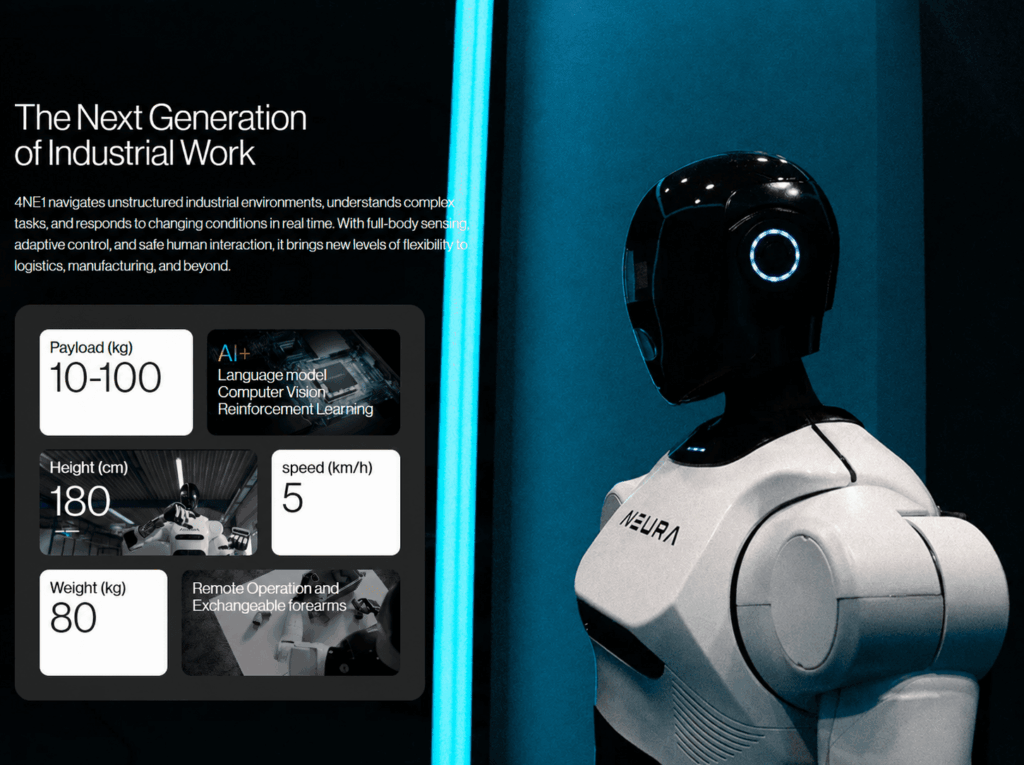
The 4NE1 from NEURA Robotics is a humanoid robot from Germany designed for industrial, logistics, and assistance tasks. Standing 180 centimeters tall, weighing around 80 kilograms, and capable of speeds up to 5 km/h, it moves through various environments in a human-like manner. 360-degree perception, sensor skin, computer vision, multimodal AI, and reinforcement learning enable precise environmental awareness and safe collaboration with humans. Depending on the model, the 4NE1 can carry loads ranging from 10 to 100 kilograms. Interchangeable forearms and remote control expand its range of applications in manufacturing, logistics, and everyday life.
| Target audience | Assessment |
|---|---|
| Private individuals | To a limited extent – 4NE1 is primarily designed for professional applications. The more compact 4NE1 Mini may also be of interest to tech enthusiasts, for educational purposes, and for experiments. |
| Self-employed / Freelancers | To a limited extent – useful for robotics consulting, training, demonstrations, research, or specialized automation projects; not as a general productivity tool. |
| SMEs | Yes, with a pilot project – suitable for handling, transport, logistics, inspection, and production tasks, provided that safety, integration, and cost-effectiveness are verified. |
| Large enterprises | Very well suited – 4NE1 is positioned for industrial workflows, multimodal interaction, machine operation, and transport tasks. |
| Developers / Research Teams | Very well suited – Python and C++ SDKs, ROS 2 interface, Digital Twin, teleoperation, and training environments are provided. |
| Education / Universities | Highly suitable, especially 4NE1 Mini – the Mini is specifically designed for classrooms, labs, research, and prototyping. |
| Industry / Logistics | Very well suited – NEURA lists machine operation, palletizing, quality inspection, metalworking, and logistics, among others, as application areas. |
| Home / Assistance | Potentially suitable – NEURA also positions the 4NE1 for everyday assistance; however, the current focus is more on professional and industrial applications. |
| Organizations with data protection concerns | Limited to good – the German provider and GDPR privacy policy are positive; specific data flows from Neuraverse, teleoperation, Digital Twin, and robot sensor technology must be clarified contractually. |
Hosting & Data
1) On-prem / local hosting
Meaning: The company operates the solution on its own hardware or within its own infrastructure. In the strictest sense, not only the application runs locally, but ideally the model as well.
2) Private cloud / data center
Meaning: The solution runs in a dedicated or more clearly separated cloud environment, often with a hosting provider or hyperscaler, but in a German data center or in a particularly controlled environment.
3) EU SaaS / managed
Meaning: The provider operates the solution itself as a service. The company uses the tool as a ready-made cloud service, ideally with EU data residency.
4) Hybrid
Meaning: One part of the processing remains internal / local / in a private cloud, while another part runs in an external cloud or EU SaaS.
5) AVV / DPA
Meaning: This is the data processing agreement or Data Processing Addendum. It governs that the provider processes personal data on behalf of the customer and is bound by the customer's instructions.
6) No training
Meaning: The provider does not use your prompts, uploads, attachments, chat histories, or outputs for training or improving the general model — ideally excluded by contract.
7) Open-source / transparency path
Meaning: There is a path toward greater technical transparency and sovereignty, for example through:
- open models
- documented components
- self-hostable parts
- traceable architecture
- export / switching options
| On-prem / local hosting | ❓ |
| Private cloud / data center | ❓ |
| EU SaaS / Managed | ⚠️ |
| Hybrid | ❓ |
| DPA / AVV | ❓ |
| No training on customer data | ❓ |
| Open source / transparency path | ⚠️ |
On-Prem / local hosting: unclear
No explicit on-premise, local hosting, or self-hosting option for the platform was found on the website.
Private Cloud / data center: unclear
No dedicated private cloud, isolated customer environment, or specific EU/EEA data center was described on the website.
EU SaaS / Managed: partial
The website describes Neuraverse as a platform and elsewhere as a cloud-based platform. However, specific EU data residency or an EU/EEA operating model is not stated on the website.
Hybrid: indirect / not available
The website describes robots, local hardware, and a connected platform, which may indicate a mixed architecture. However, a clearly documented hybrid hosting model for customers in the sense of internal/local plus external processing is not specified.
DPA / DPA: unclear
No AVV, DPA, or reference to a data processing agreement was found on the website.
No training: indirect / not available
The website describes Neuraverse as a continuously learning operating system and highlights training data as well as learning effects between deployments. A statement that customer content, prompts, uploads, histories, or outputs are not used for training was not found on the website; an opt-out is also not specified.
Open source / transparency path: partial
The website refers to Neuraverse as an open platform and MiPA as an open, interoperable platform. However, specific open-source components, source code, licensing information, or self-hostable open-source elements were not specified on the website.
Data processing
The website describes a connected robotics platform called Neuraverse through which robots, people, and data are brought together. It mentions a continuously learning or cloud-based platform as well as training data. However, for EU/EEA users, the website lacks the key information about actual data processing: server locations, data flows, subprocessors, data residency, and contractual safeguards are not specifically disclosed.
Conclusion
For a European tool directory, the current level of documentation on the website is not sufficient to assess NEURA Robotics as clearly usable in compliance with DSGVO/GDPR across the entire EU/EEA area. Positive aspects include the available privacy information and the company's headquarters in Germany. However, the decisive evidence for the practically relevant hosting and compliance questions is missing. Therefore, the overall classification is 'unclear'.
Sources
- https://neura-robotics.com/de/datenschutzbestimmungen/
- https://neura-robotics.com/legal/
- https://neura-robotics.com/
- https://neura-robotics.com/de/neuraverse
- https://neura-robotics.com/neuraverse
- https://neura-robotics.com/neura-qualcomm-collaboration-physical-ai/
- https://neura-robotics.com/neura-robotics-launches-technological-revolution/
- https://neura-robotics.com/europes-largest-physical-ai-training-center-neura-tum/
Strengths & weaknesses at a glance
| Strengths | Weaknesses |
|---|---|
| • German manufacturer with headquarters in the EU | • 4NE1 remains in the pre-commercial or early commercial deployment stage |
| • Combination of humanoid hardware, sensor technology, and the proprietary AI platform AURA | • Extensive integration, risk assessment, and occupational safety review required |
| • Official SDK and ROS 2 support | • No complete public information available on cloud architecture, robot telemetry, and training data usage |
| • Digital twin and teleoperation | • No publicly available product-specific AVV/DPA found |
| • Applications in industry, research, service, and education | • No publicly documented fully local execution of all AI functions |
| • Published reservation and delivery information | • Neuraverse is a proprietary ecosystem, even though open interfaces are available |
| • MiPA as a modular service and assistance robot with API access |
Reviews
0 reviews in total
There are no confirmed reviews for this tool yet.
Submit review
Your review will only become visible after email confirmation. This protects the portal against abuse.
Report review
Please select the reason why this review should be checked.
GDPR-compliant usage possible?
There is a privacy policy available on the website, and the provider identifies itself in the legal notice as the responsible entity in Germany. However, for a reliable assessment of GDPR compliance throughout the EU/EEA, the website lacks essential information on server/data center locations, EU data residency, AVV/DPA, subprocessors, opt-out from AI training, and certifications. As a result, a Europe-wide compliance assessment for the practical use of the tool is too incomplete based on the website alone.
Positive
Positively documented are a published privacy policy, the explicit reference to the GDPR, and information on data subject rights. In the legal notice, NEURA Robotics GmbH, based in Metzingen, Germany, is named as the responsible entity.
Negative
Negative is that no specific information was found on the website regarding server locations or data centers, no documented EU data residency, no AVV/DPA, no list of subprocessors, no statement about a contractual exclusion of AI training with customer data, and no relevant certifications such as ISO 27001 or SOC 2. The privacy policy also mentions Google Analytics and refers to a transfer of personal data to Google in the USA.
Server location
Not specified on the website. Server log files are mentioned in the privacy policy, but no location of the servers or data centers is stated. In addition, for Google Analytics, a transfer of personal data to Google in the USA is described.